Extract
Digital text, tables, headings, image references, captions, and page boundaries are extracted through multiple engines.
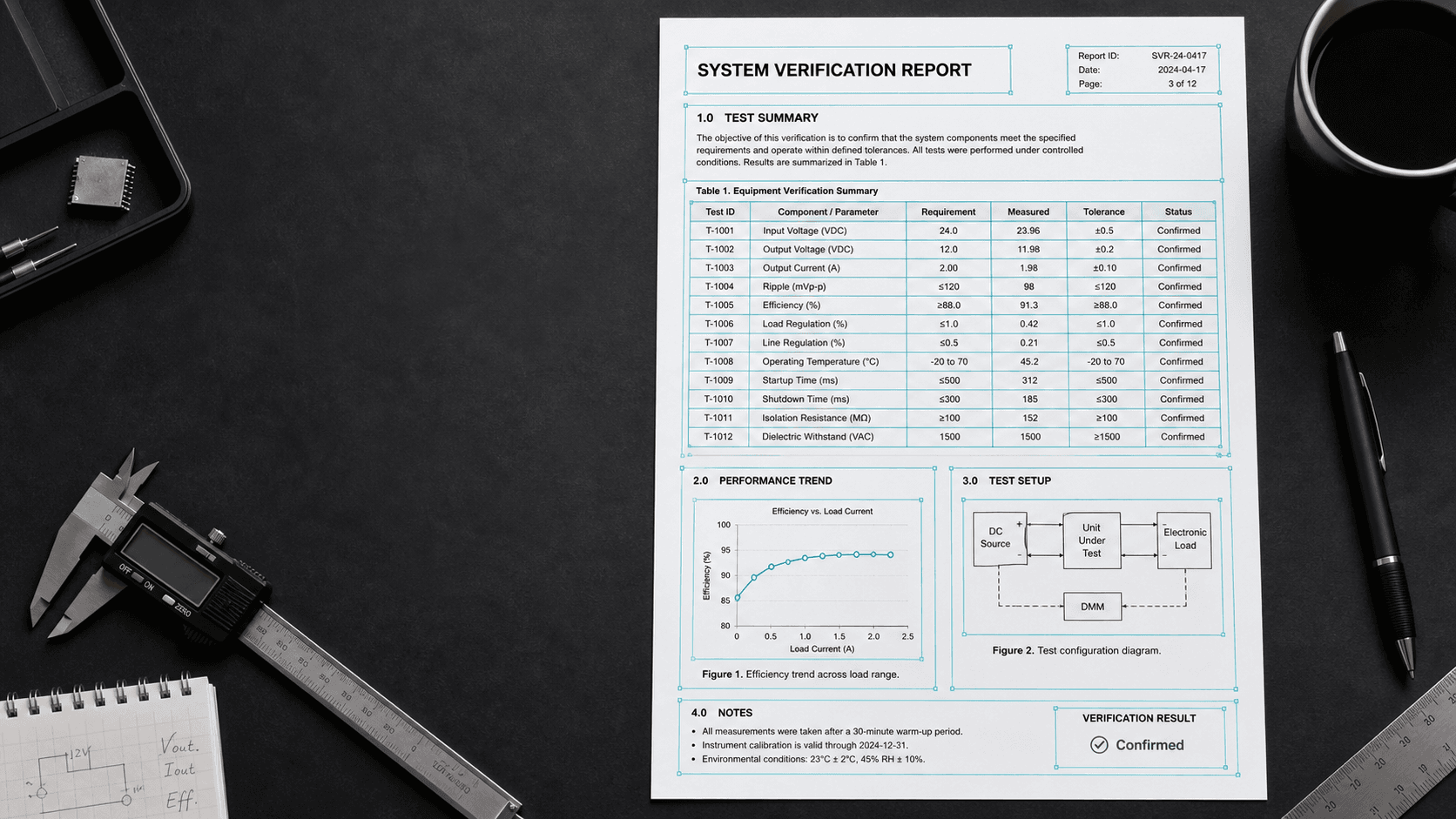
Verified document conversion
Convert complex PDFs into Markdown: readable text with simple markers for headings, lists and tables. Use it for AI, search, documentation and archives. Every page gets a quality verdict.
For research, engineering, and document teams. Evaluation access requires account verification and KYAMOS approval. Already approved? Open the converter.
Answer plus verdict
A normal converter returns text. KYAMOS runs independent extraction paths, compares critical values page by page, and preserves uncertainty instead of hiding it.
Digital text, tables, headings, image references, captions, and page boundaries are extracted through multiple engines.
Optional OCR provides independent evidence for scans and difficult pages. It is checked, not accepted blindly.
Each page receives a score and a traceable verdict: confirmed, likely, uncertain, or failed.
Quality report
The document verdict is derived from page-level evidence. A plausible-looking page is not enough.
Confirmed
All required checks passed with no unresolved page-level issues.
Likely
Conversion succeeded using a lighter evidence set.
Uncertain
Markdown is available, but one or more pages need review.
Failed
No usable verified result was produced.
Regression proof
Confirmed regression result recorded 27 July 2026. This is a test proof point, not a claim that every PDF is perfect.
Asynchronous API
Large documents continue processing after the browser disconnects. The web gateway uses KYAMOS account authentication and user-bound job tokens.
POST /api/pdfmd/jobs?profile=verified&ocr=auto
Content-Type: multipart/form-data

202 Accepted
{
  "job_id": "abc123...",
  "status": "queued",
  "status_url": "/api/pdfmd/jobs/abc123..."
}

GET /api/pdfmd/jobs/{job_id}
GET /api/pdfmd/jobs/{job_id}/markdown
GET /api/pdfmd/jobs/{job_id}/artifacts
Manifesto
PDFs contain operational memory: proposals, tables, legal terms, diagrams, and decisions. If a converter silently loses a row or changes a number, it corrupts knowledge. Our promise is clean Markdown, page-level proof, and honest uncertainty.
Operational documents
Private by design
Account approval, service tokens, upload limits, rate limits, and per-user job ownership.
Website evaluation jobs expire after seven days. Private deployments can use a customer-defined retention period.
Private beta
Pilots are quoted per project, based on document volume, quality checks, support and deployment needs. Contact us to agree the scope and price. Evaluation access requires approval.
A bounded document and page allowance for product assessment.
Request accessHigher limits, full downloads, quality reports, and API access.
Discuss a pilotPrivate infrastructure, retention controls, audit support, and service terms.
Discuss a pilotFAQ
No. Optical character recognition reads text from images. KYAMOS combines multiple PDF conversion engines, optional OCR, and page-level quality checks.
The document is marked uncertain. The quality report identifies the affected page, its score, and the unresolved evidence.
Yes. VPN-only, customer-network, and self-hosted deployment are available for private pilots.
No. Customer files are not used for model training unless a separate written agreement explicitly permits it.
For research, documentation and knowledge-management teams. Tell us about your document types, page volume, required outputs and privacy needs.
Pricing: quoted per project. Scope, computing needs, validation checks and support determine the quote. Contact us to agree access and deliverables before work starts.
A conversion quality verdict is not a legal or scientific endorsement of the source document. Evaluation access remains approval-based.