Phase-change heat storage: a documented example
Existing September 2026 results for an assumed 40 × 30 × 10 mm aluminium-silicon sample. The model follows heat spreading, melting and freezing, without liquid flow or a container.
| Test | Comparison | Recorded result | Meaning |
|---|---|---|---|
| Analytical verification | 31 simplified cases against exact mathematics | 434 / 434 checks passed | Checks the numerical method with an invented test material. |
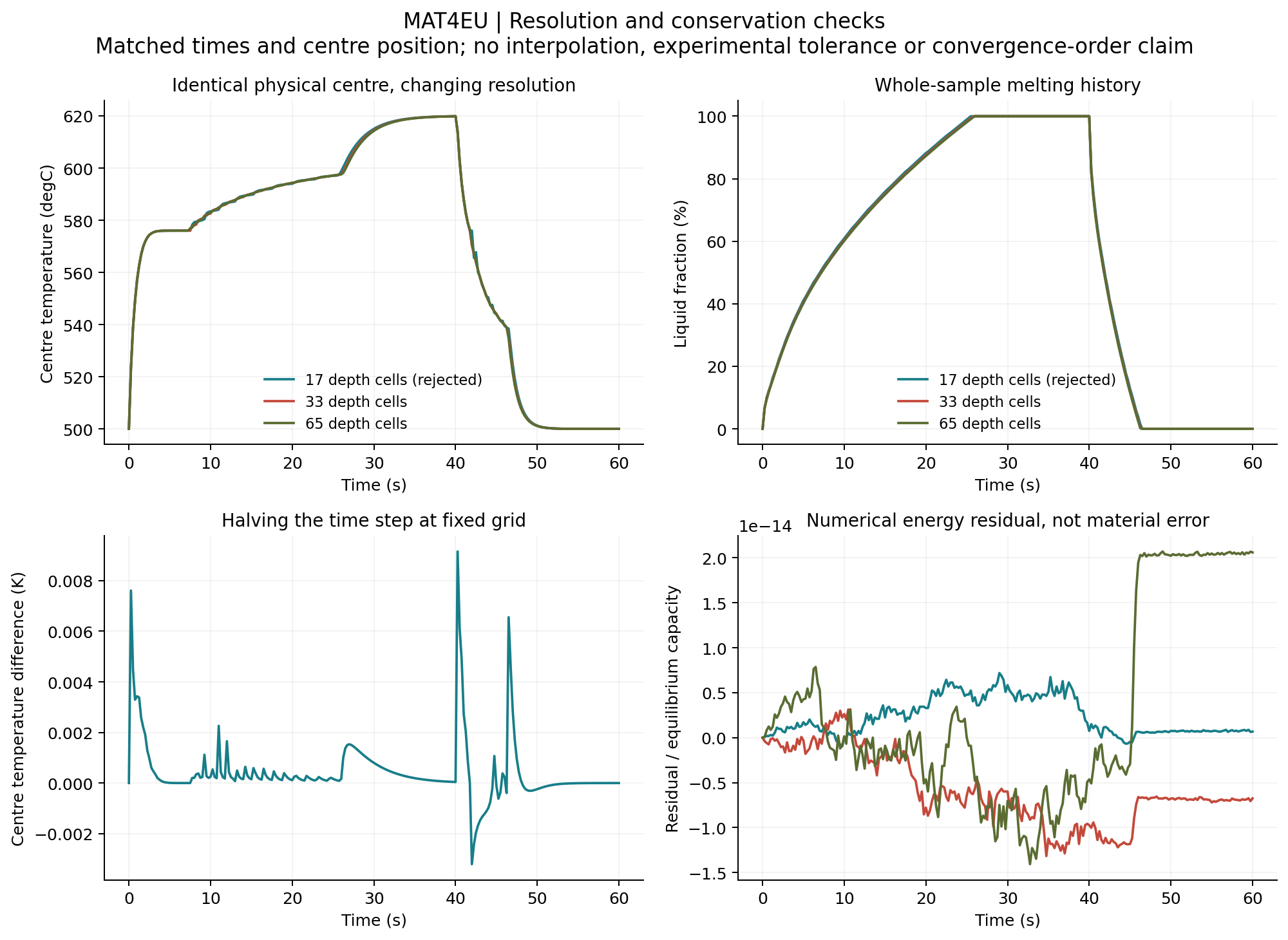
| Working-grid check | 33 versus 65 depth cells | 1.4207 K centre-temperature difference | Within the declared 3 K limit. One kelvin of difference equals one degree Celsius. |
| Time-step check | Working time step versus half that step | 0.0092 K centre-temperature difference | Checks sensitivity to how far each calculation advances in time. |
| Rejected coarse grid | 17 versus 33 depth cells | 5.7487 K centre-temperature difference | Above the 3 K limit. The raw campaign remains FAIL: 219 of 220 checks passed. |
Hardware and repeatability
Recorded on NVIDIA Tesla V100 graphics processors. The saved material study gives identical histories and fields when the calculation is shared by one, two and four processors. This is a consistency check, not a claim of universal speedup.
What remains unproven
Independent tests on the actual alloy, complete storage-device efficiency and real equipment charging time are not established. Separate communication-software memory checks were not clean; passing numerical checks does not erase those limitations.