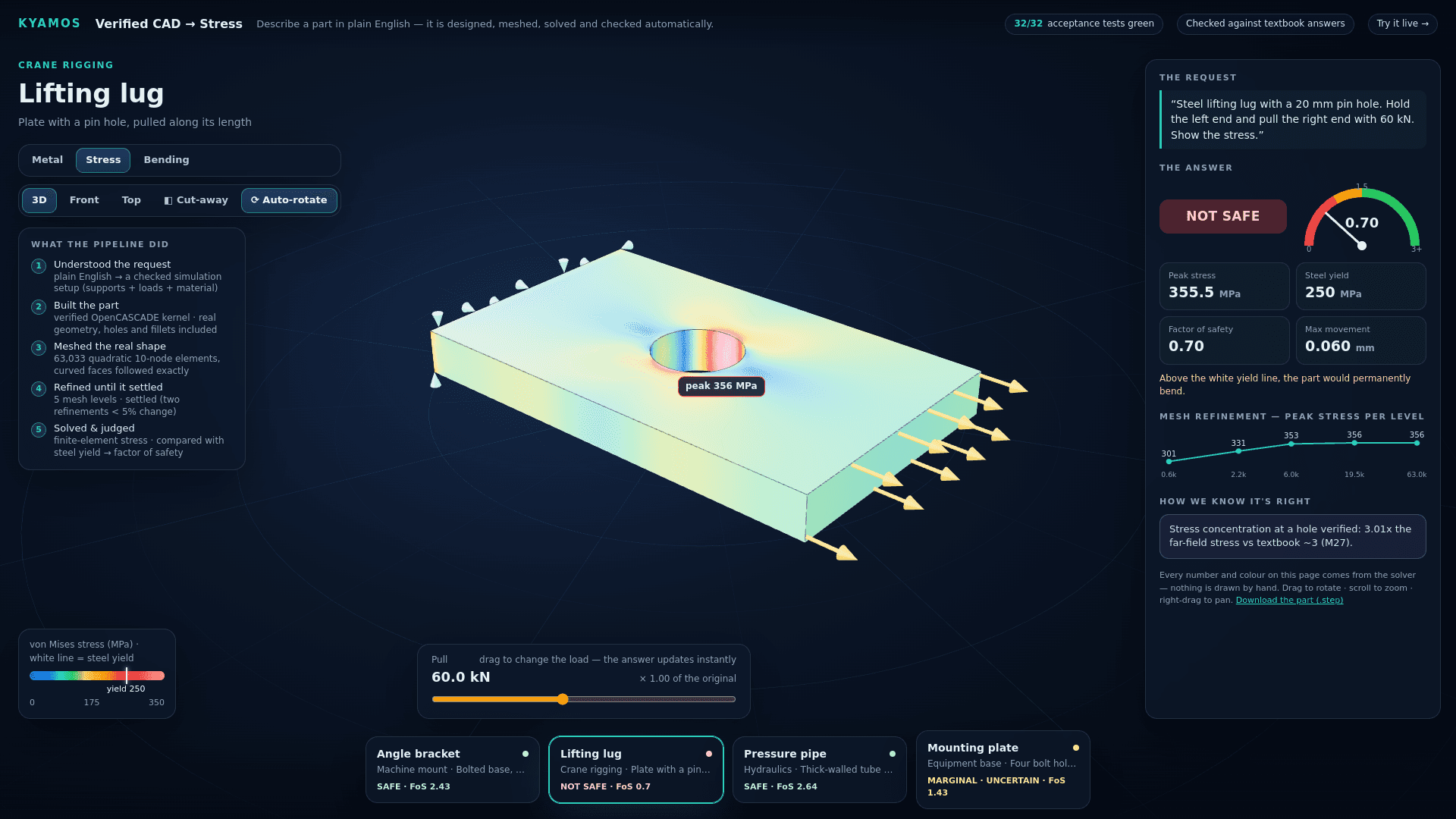
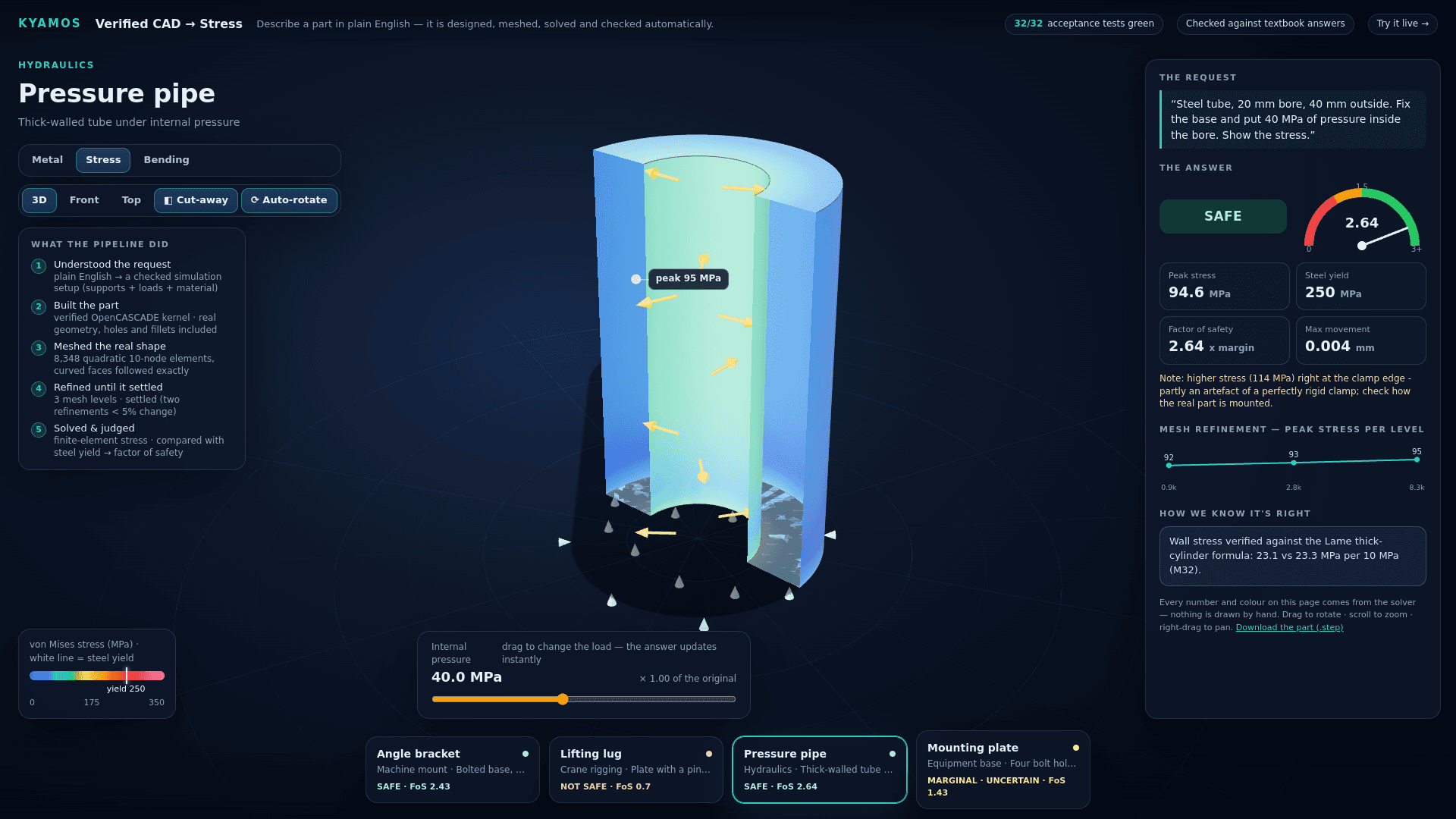
Drag to rotate · scroll to zoom · switch between Metal, Stress and Bending · drag the load slider and the verdict updates instantly. Every number and colour comes from the solver.
Describe a part and how it is loaded. KYAMOS builds a computer-aided design (CAD) model and divides it into small connected pieces: the finite-element method (FEM). It calculates stress and a safety margin under the stated assumptions. A model-based verdict supports engineering review; it is not safety certification.
Drag to rotate · scroll to zoom · switch between Metal, Stress and Bending · drag the load slider and the verdict updates instantly. Every number and colour comes from the solver.
“Uncertain” means the stress was still changing when the mesh-size budget ran out. The tool never overstates safety: an unsettled result is labelled as such rather than rounded up to “safe”. The hot bracket is heat turning into stress: its temperatures are solved first on the real shape, then fed into the stress solver. Bolted rigidly flat, it cannot grow as it warms — which is why real hot parts use slotted holes or flexible mounts. Hot steel is also weaker than cold steel, so every point is judged against the strength and stiffness it keeps at its own temperature — the heated rail sits right at the edge (factor 1.01). The pipe start-up follows the warm-up second by second: once warm it is very safe (factor 87), but in the first seconds the hot inside expands against the cold outside (factor 1.22). Drag the time slider or press play.
Plain English becomes a checked simulation setup: which faces are held, where the loads go, what the part is made of. Ill-posed requests are refused, not guessed.
OpenCASCADE, the software engine for building and measuring engineering shapes, constructs the part using a fixed software version — holes and rounded edges included.
The shape is divided into small connected calculation pieces. Curved, 10-point pieces approximate rounded surfaces and resolve bending and hole edges more closely than straight-sided pieces.
The mesh is made finer level by level until the peak stress stops changing. If it has not settled, the answer says so.
Finite-element stress is compared with the material’s yield strength to give a factor of safety: safe, marginal or not safe.
Every capability is locked in by automated checks against problems whose answer is known exactly. The whole system re-runs these checks end to end before anything is shown.
Pair it with the KYAMOS AI design agent: describe a part, several AI designers propose it, the verified kernel checks each proposal, and the one that meets your specification is built — then simulated here.
For engineers checking loads, deformation and structural behaviour. Tell us about your geometry, inputs and the decision you need to make.
Pricing: quoted per project. Scope, computing needs, validation checks and support determine the quote. Contact us to agree access and deliverables before work starts.
Demonstrations do not certify a production design.