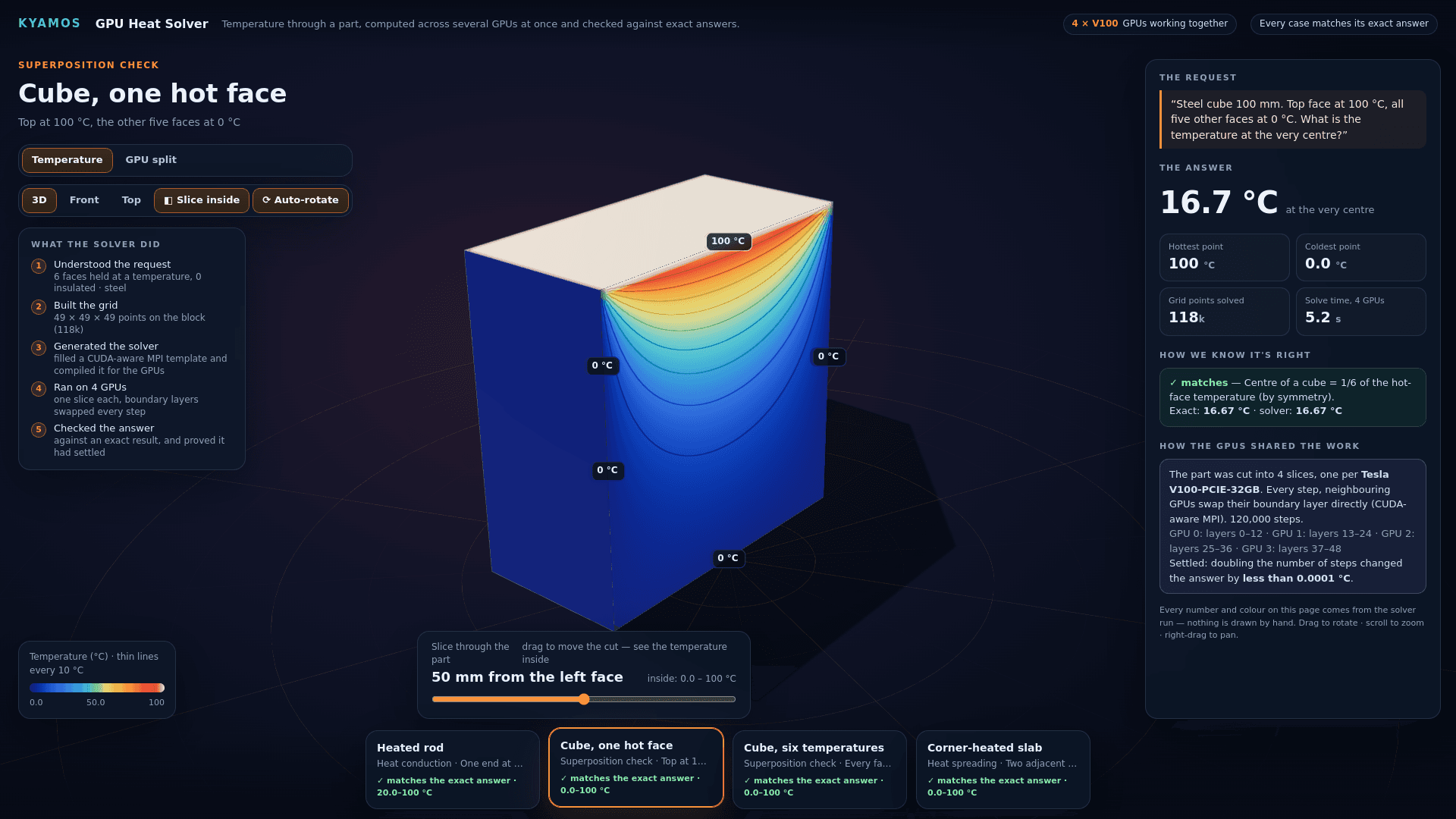
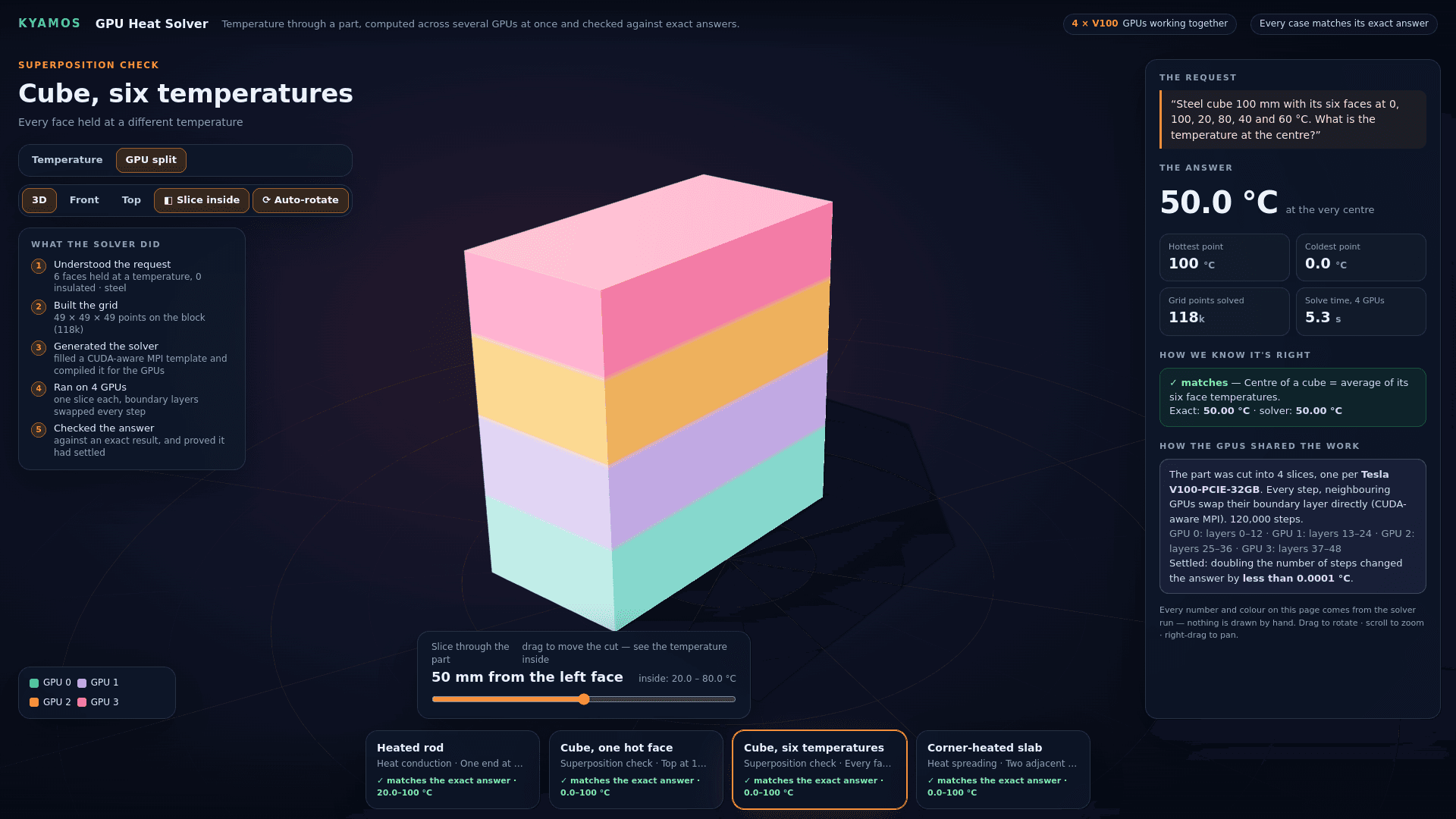
Drag to rotate · scroll to zoom · “Slice inside” and drag the slider to see the temperature inside the part · on the block cases, “GPU split” shows which GPU computed which slice. Every number and colour comes from the solver run.
Describe what heats the part and how it cools — a chip under a heat sink, hot fluid in a pipe, one edge held hot, the rest cooling in air. KYAMOS solves the heat flow on the real shape, holes and fins included, and shows the temperature through the whole part. For block-shaped problems it can also write a GPU solver on the fly and run it across four NVIDIA V100 GPUs working together.
A graphics processing unit (GPU) performs many calculations at once. A solver is the program that carries out the physics calculation; its results still depend on the material, loads and cooling assumptions.
Drag to rotate · scroll to zoom · “Slice inside” and drag the slider to see the temperature inside the part · on the block cases, “GPU split” shows which GPU computed which slice. Every number and colour comes from the solver run.
Solved on the actual CAD geometry with curved quadratic elements, in real units: watts, W/m²K, °C. Each result is checked — against an exact formula where one exists, and always against conservation of energy (every watt in must come out).
Hottest point 56.4 °C · 15.000 W in = 15.000 W out
Heat lost 24.445 W = the exact series-resistance formula
Heat removed 5.631 W vs the fin equation 5.632 W
Heat flows around the holes · 15.704 W in = out
Straight-line profile — zero deviation at every point
Centre 16.67 °C = exactly 1/6 of the hot face
Centre 50.00 °C = the average of the six faces
Centre 50.00 °C = halfway, by mirror symmetry
These are problems whose answer is known exactly, so they prove the whole chain — understanding the request, generating and compiling the solver, splitting the work across GPUs — gives the right result.
Plain English becomes a checked setup: which faces are held at which temperature and which are insulated. A problem without any fixed temperature is refused, not guessed.
The temperatures and material go into a calculation template. CUDA runs it on NVIDIA graphics processors; MPI shares data between the processors working on the same problem.
The part is cut into slices, one per GPU. On every step neighbouring GPUs swap their boundary layer directly, GPU to GPU.
The solver runs hundreds of thousands of steps. Doubling the number of steps proves the answer no longer changes.
The result is checked against an exact answer and painted on the part — with a slice you can move through the inside.
Each GPU owns one slice of the part. After every step, neighbours exchange their shared boundary layer directly between GPU memories (CUDA-aware MPI), so the slices behave as one piece of metal. The same approach scales from a desk-side server to a cluster.
The GPU solver handles block-shaped parts with faces held hot, cold or insulated. Parts with holes, fins and curves are solved by the real-shape heat solver shown above, which meshes the actual CAD geometry — the same approach as the KYAMOS stress solver.
We build and run GPU solvers for heat, stress and coupled physics on our own GPU servers. Tell us about your problem.
For engineers investigating heat transfer in components. Tell us about your geometry, inputs and the decision you need to make.
Pricing: quoted per project. Scope, computing needs, validation checks and support determine the quote. Contact us to agree access and deliverables before work starts.
Demonstrations do not certify a production design.