Monitoring and control for small photovoltaic (PV) solar parks. An inverter turns electricity from solar panels into power the electricity grid can use.
This KYAMOS research project explores how measurements, a simulated electricity network and artificial intelligence can help adjust solar output when grid voltage rises.
A Raspberry Pi, a small on-site computer, collects inverter measurements and sends control commands.
Pandapower software represents the network and calculates how changes in solar output affect its voltage.
Reinforcement learning, where artificial intelligence learns through trial and feedback, explores ways to reduce solar output only as needed.
Presentations and demonstrations from the inverter project.
Technical DemoAI-assisted inverter monitoring and control platform demonstration.
Watch on YouTube ↗
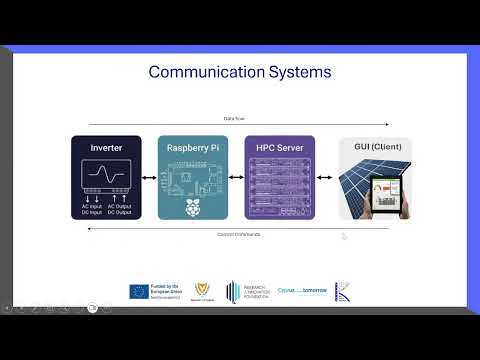
PresentationProject presentation for PV inverter control and grid-stability workflows.
Watch on YouTube ↗
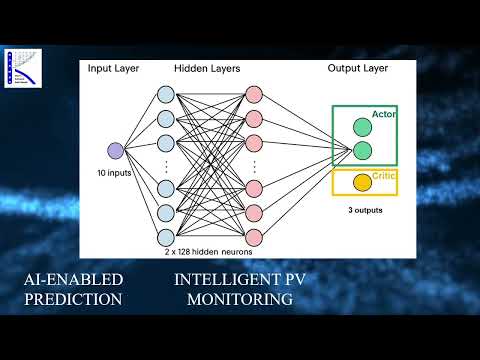
Project VideoGPU and AI workflow for PV inverter control in grid-stability scenarios.
Watch on YouTube ↗Control of Small-Scale PV Parks for Grid Stability Using Artificial Intelligence
Journal of Multidisciplinary Engineering Science and Technology · January 2026
The paper reports smoother control with less unnecessary output reduction than a fixed-rule comparison in its simulated network.
Read the publisher paper (PDF)The study uses a simplified solar park and generated sunlight patterns. These are simulation results. Field validation, larger networks and coordinated control of multiple inverters remain future work.
The publication does not establish measured energy savings or a general prediction-speed or accuracy figure for this project.
Project ENTERPRISES/ENERGY/1123/0033 is funded by the European Union — NextGenerationEU and the Republic of Cyprus through the Research and Innovation Foundation, under Component 6.1 REPowerEU of the Cyprus Recovery and Resilience Plan.